




At a seminar led by the Director of ShoreAdvantage during a Jobs360 Open House event, the worry that AI is replacing jobs came up early and often. The answer wasn’t reassuring in the way most candidates hoped for — but it was more useful. Some entry-level work is genuinely changing, and candidates who understand what that means are walking into interviews with a real edge over those who don’t.

AI Is Changing the Starting Line
By the time you are applying for your first role, AI is already part of most workplaces. It drafts documents, sorts data, summarizes long reports, handles routine queries, and fills calendars. Tasks that used to take a new hire an entire morning now take a tool about thirty seconds.
That is not a threat to fresh graduates as a group. It is a shift in what entry-level work actually looks like, and what employers are hoping you will bring to it.
The New Entry-Level Reality
A few years ago, being willing to do repetitive admin tasks was a reasonable entry point into most organizations. Willingness was enough. Today, the tools exist to remove most of that work from the equation, so employers are starting from a different question: what can this person do that the software can’t?
The roles hit hardest are the ones built almost entirely around task execution — data entry, basic document processing, first-line customer queries. If your value as a candidate rests only on being able to follow instructions and use a spreadsheet, you are competing with software. The candidates getting shortlisted are the ones who show up with something past that baseline.
What Employers Value Now
Across the sectors Jobs360 places talent in — accounting, admin and office support, ICT, marketing, and engineering — what stands out in entry-level candidates right now is a specific combination:
- Adaptability: picking up new tools without needing much hand-holding
- Communication: explaining your reasoning, not just executing a task
- AI literacy: basic familiarity with the tools used in your target industry
- Problem solving: handling situations that don’t come with a ready-made template
Employers are not expecting AI experts at the entry level. They are looking for people who are curious, honest about what they don’t know yet, and capable of learning fast.
Your Human Advantage
AI is fast, consistent, and tireless. It is also contextless, unaccountable, and genuinely bad at judgment calls where the situation doesn’t match a familiar pattern.
That gap is where your value lives. Empathy, ethical reasoning, creative thinking when things go sideways, managing a relationship through a difficult conversation, knowing when the technically correct answer is the wrong one for this specific situation — none of that is territory AI is taking over. Employers know this. The candidates who can demonstrate those qualities are the ones who get hired, and the ones who get asked to stay.
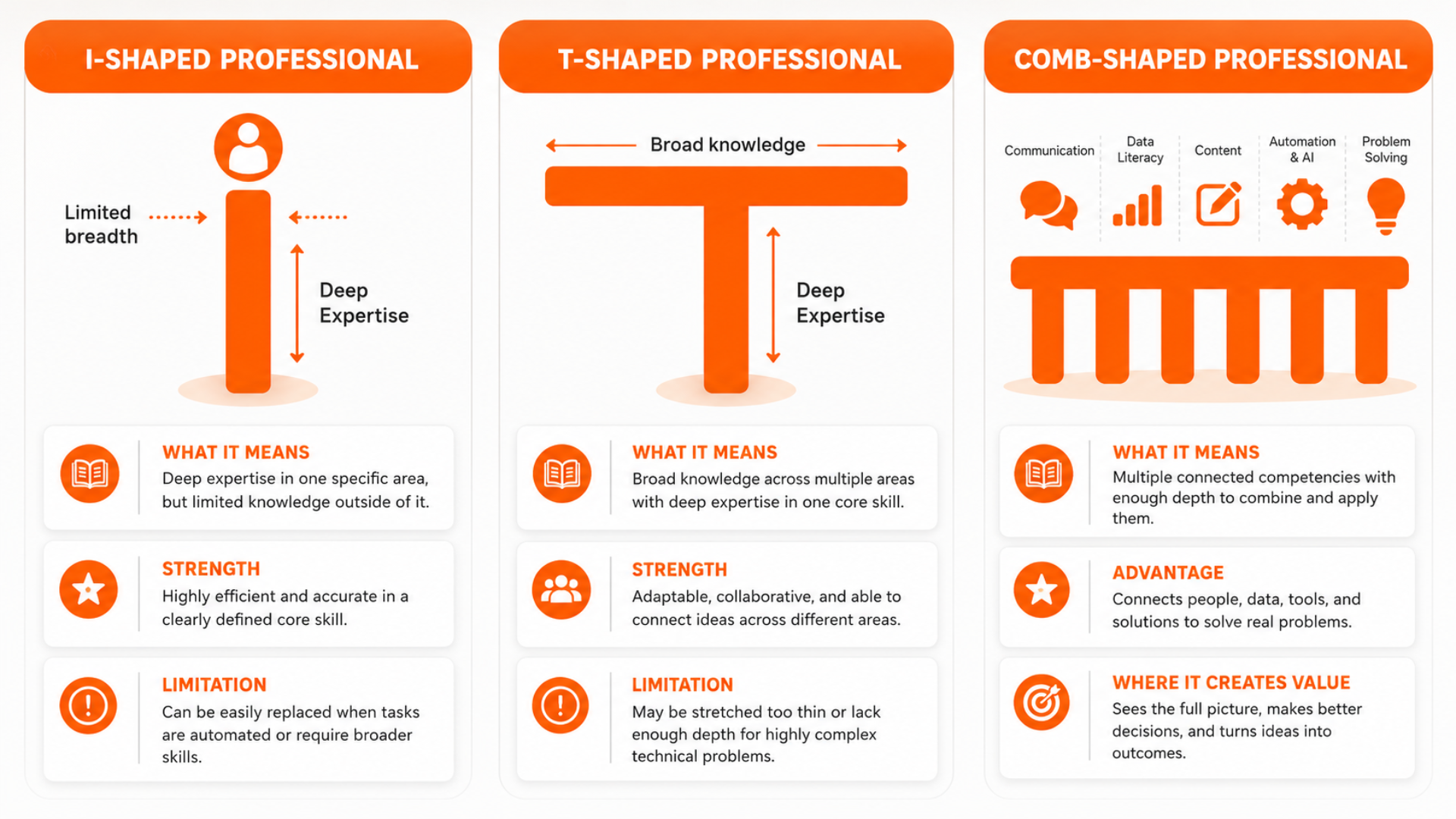
From I-Shaped to Comb-Shaped: The Career Profile That Gets You Hired
Career shape is worth thinking about early because it determines how much value you can offer across different situations.
An I-Shaped professional has deep expertise in one area. Useful in specialist roles, but more exposed when that one skill becomes automated or less in demand.
A T-Shaped professional pairs one deep skill with broader supporting knowledge: communication, basic business awareness, the ability to work across teams. More adaptable, and more useful to a wider range of employers.
A Comb-Shaped professional builds several complementary skills that reinforce each other: AI literacy, data awareness, communication, content creation, problem solving, and business context. Each adds value on its own; together, they let you connect knowledge across disciplines rather than just execute within one.
Modern organizations tend to reward Comb-Shaped people because the work that matters most now rarely fits neatly inside one function. Give yourself more than one direction to grow in, and make sure employers can see it in what you produce.
AI as Your Thinking Partner
Once you start treating AI as a working tool rather than something to be anxious about, the practical question becomes: where does it actually help?
Brainstorming is one of the most underused starting points. Give AI a clear brief and ask for ten angles on a problem. Most of them won’t be useful, but two or three usually are. Research is another: AI can pull together a broad landscape of information quickly, which frees you to evaluate and apply it rather than spend your time hunting it down. Drafting is a third solid use. A first AI draft, properly reviewed and reworked with your own judgment, is usually faster and better-structured than starting from nothing.
The Human-in-the-Loop
Before any AI output goes near a client, a manager, or a real decision, it needs a human check. This is the human-in-the-loop: you, reading it properly, not just glancing at it.
AI gets facts wrong. It misses context. It gives confident answers to questions it does not fully understand. Your job is to catch that before it becomes your mistake. Building that review habit early, while you still have the space to learn without high stakes, is one of the more practical things you can do for your career.
How to Work With AI
A simple four-step approach covers most situations:
- Plan. Define what you need, why you need it, and what a good result looks like. A vague brief gets you a vague output.
- Use AI. Apply it at the right stage: generating ideas, drafting, summarizing, or basic analysis.
- Review. Check everything. Verify facts. Read for tone, accuracy, and context before you accept anything.
- Improve. Add your specific knowledge of the situation, your professional voice, and your judgment. The final product should be yours.
Try this on a real project before you need to discuss it in an interview, and you will have a concrete example ready to walk through when someone asks how you work with AI.
Build Proof, Then Keep Building
A resume line that says “familiar with AI tools” is easy to write and easy to ignore. What gets attention is a real, specific example: a mock report, a portfolio piece, a dashboard, an automated tracking sheet, a short content series. Something that shows you took AI, applied it to an actual problem, and produced something you would be comfortable presenting.
If you are looking for upskill training for AI jobs in the Philippines, the Technical Education and Skills Development Authority (TESDA) is a solid starting point. It runs AI and data-related programs open to job seekers at low or no cost, and several online platforms offer free options too. Treat AI fluency the way you would treat any professional skill: something worth putting real effort into before you need it, not after.
The entry-level market is adjusting, not closing. The candidates who figure that out now, and start building accordingly, are the ones who walk in with the clearest advantage.